An air-source heat pump can provide 24-7 warmth at a lower cost than oil or gas heating. But only if the conditions are right! It’s essential that you’re well-informed to avoid the pitfalls. So arm yourself with the information you need by reading this complete guide to air-source heat pumps in Ireland.
What is an air-source heat pump?

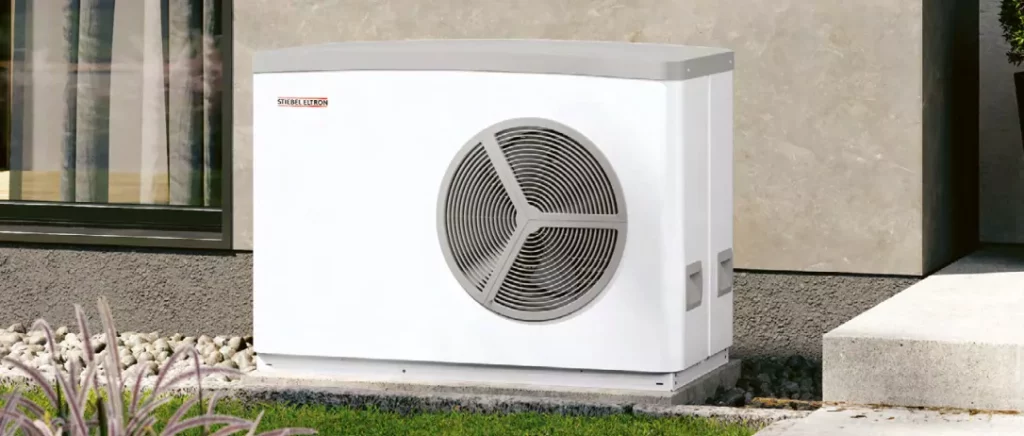
An air-source heat pump extracts warmth from outdoor air and delivers it to your home, usually by circulating warm water through radiators or underfloor heating. This system is called “air-to-water”. Air-to-water heat pumps are the most popular kind in Ireland and will be the main focus of this guide.
Air-source heat pumps can be highly efficient. Specifically, they can deliver around 4 units of heat for every unit of electricity that they consume. High efficiency means lower energy bills for homeowners. So an air-source heat pump CAN be much cheaper to run than an oil or gas boiler.
Will an air-source heat pump save you money?
It depends!!!
Many Irish houses leak heat so badly that it’s practically impossible to keep them warm 24-7. So their occupants make do with a “blast of heat” each evening, leaving the house uncomfortably cold the rest of the time. Heat pumps are not a good match for this kind of start-stop usage.
Where heat pumps shine is in a well-insulated home with thermostat-controlled heating. In this context, your heat pump will keep your home cosy throughout the day and night. And at a much lower cost than with oil or gas heating.
But what if your home has a medium level of insulation (HLI of 2 – 2.3)?… In this case, you’ll need to weigh up the value that you place on comfort. This is because going air-source may not “pay for itself” in terms of lower bills. But a home energy upgrade will immediately make your home more cosy. So it’s not a financial toss-up, but a personal value decision: How much do you value warmth?
There’s more!
Heat pump performance also depends on quality design and fitting.
This makes choosing the right installer key. Because the difference between a poor heat pump installation and a great one is not just substantial. It’s game-changing.
To identify a good installer, ask some technical questions and make sure they can give you clear and compelling answers. For example:
- “What will the heat pump flow temperature be, and why?”
- “What will the SCOP (efficiency score) of the system be? How did you calculate this number?”
- “Do you plan to upgrade my radiators? Why/why not?”
- “What will the flow rate be? What will the flow velocity be?”
Result: Heat pump running costs range from €300 to €8,000 per year
Shocking, I know. Here’s why the variation is so wide:
House size. The more space to heat, the more it’s going to cost.
Insulation: Better insulation means you need less heat for the same space.
Heat pump efficiency: An efficient heat pump delivers the same heat with less electricity. Unfortunately, the Irish heat pump industry is not consistent at delivering high efficiency levels.
Electricity tariffs: You can save 10-20% by changing to the best electricity tariff every 12 months.
Thankfully, the calculator below cuts through the confusion. Use it to quickly estimate the running cost of a heat pump for your home:
Ready for a Warmer Home and Lower Bills?
Air-source heat pump grants in Ireland
You can now get a grant of up to €12,500 for an air-source heat pump in your home. This includes up to €6,500 for the heat pump, €2,000 for central heating upgrades, and €4,000 Renewable Heat Bonus when switching from fossil fuels.
Here are the main requirements to qualify:
- Have a home built before 2021
- Get a Technical Assessment done (for homes built before 2007, unless your BER shows a Heat Loss Indicator ≤ 2.3). Homes built from 2007 onward only need a Self-Declaration Form
- Upgrade the home’s insulation if it’s not already adequate
- Use an SEAI-registered heat pump installer
The total grant package is up to €12,500 for houses and up to €9,500 for apartments (from February 2026).
Air-source heat pump installation costs in Ireland
Fully installed, an air-source heat pump can cost anywhere from €10,000-€23,500 in Ireland. With the new Heat Pump System Grant of up to €12,500, the cost after grants can be as low as €0-€11,000.
It often makes sense to upgrade your insulation alongside installing a heat pump. This is because insulation upgrades provide a triple benefit when done alongside a heat pump installation:
- A smaller heat pump unit will be sufficient
- You’ll need fewer radiator upgrades, if any
- Running costs will be lower
Overlooked Heat Pump Benefits
Safety: Air-source heat pumps emit no carbon monoxide and don’t require an on-site supply of flammable gas or heating oil.
Convenience: A heat pump works off your pre-existing electricity supply. No need for gas connections or oil supplies.
Garden space: Let’s face it – oil tanks are ugly and a waste of prime garden space! Switching from oil to an air-source heat pump can set that space free.
Ready for a Warmer Home and Lower Bills?
Bonus Information
How much insulation is enough for a heat pump?
Now you know that a home needs to be well-insulated for an air-source heat pump to perform well. But how well-insulated does it need to be? And is your home heat pump-ready?
The only way to be sure is with a heat pump survey. This involves a surveyor checking your property to calculate the “Heat Loss Indicator” (HLI). The HLI measures how quickly your home loses heat. Low scores are better as they indicate that your home retains heat well. You generally need a HLI score under 2 for a heat pump to make sense.
Most home will need all the following to be heat pump-ready (HLI under 2):
- Attic/rafter insulation
- Wall insulation
- Underfloor insulation
- Double glazing (at a minimum)
Irish houses built since 2011 should be heat pump ready, even without any insulation retrofits. This is because new building regulations with higher energy efficiency standards entered force that year. Older houses may need insulation upgrades first.
Insulation is so critical to heat pump performance that the SEAI have made adequate insulation a precondition to qualify for heat pump grants. Specifically, you must achieve a HLI under 2 to get a heat pump grant (2.3 in uncer certain exceptions). Here are the details:
Monobloc vs split
There are two main kinds of air-to-water heat pump: Monobloc and split.
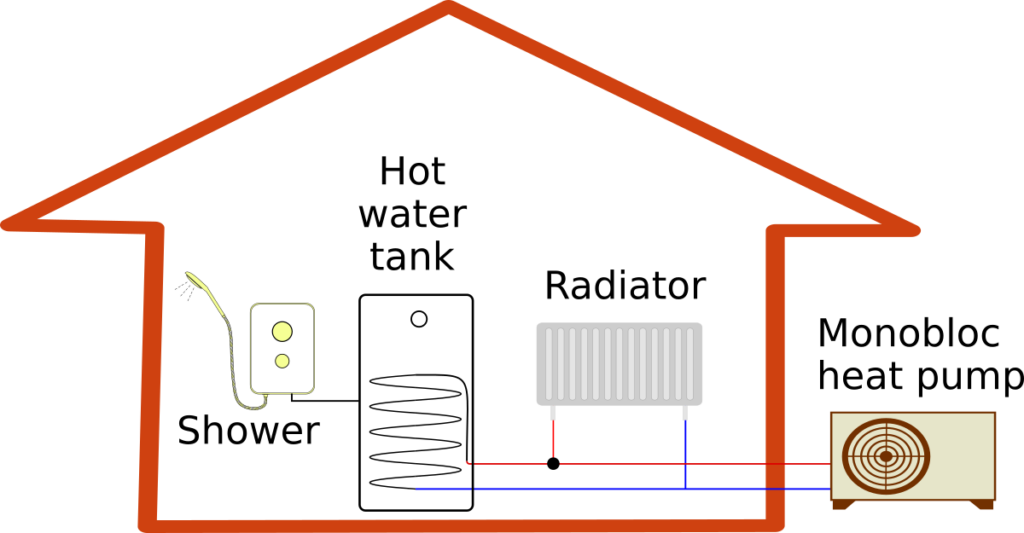
With a monobloc system, there’s a single outdoor unit that contains all the heat pump components:
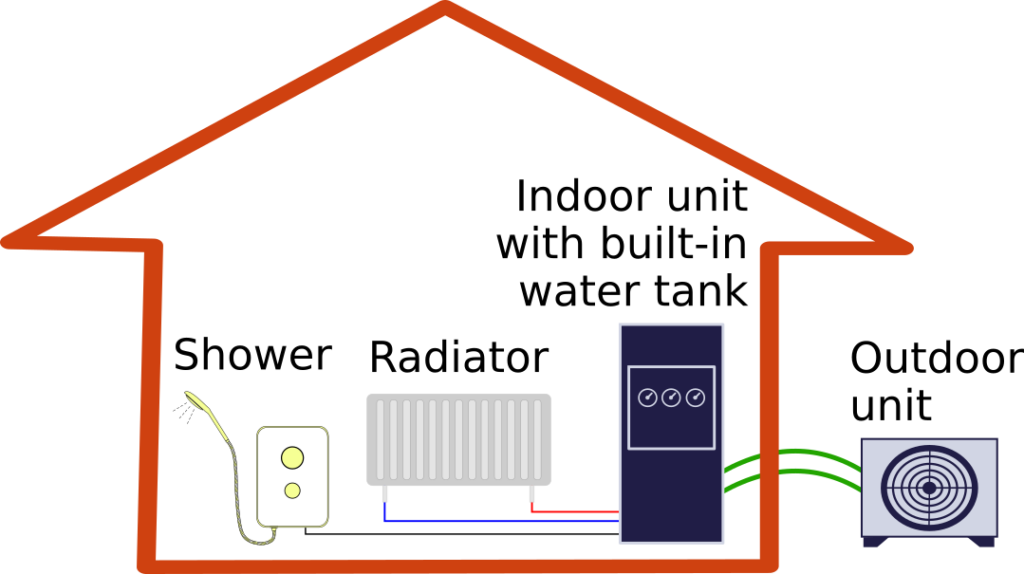
However, a split system has two segments: An indoor unit and an outdoor unit. The outdoor unit contains a fan, while the indoor unit contains a heat exchanger. It’s also common for heat pump indoor units to have an integrated hot water tank:
It’s not worth getting hung up about the difference between monobloc and split systems. Differences in performance between the two kinds are small, and any reputable installer can advise on the best air-source heat pump layout for your needs. Instead, it’s better to focus on getting a high-quality heat pump brand, a reputable installer, and plenty of insulation for your home.
Heat pumps and radiators
While radiators are most powerful at high temperatures, heat pumps produce heat most efficiently at low temperatures. So a heat pump is not always a simple drop-in replacement for an oil or gas boiler.
But there are ways to make a heat pump work well with radiators:
Super-insulate your home: With enough insulation, even a few lukewarm radiators are enough to keep a home warm. And running costs will be very low.
Get a radiator upgrade: Modern aluminium radiators pump out more heat than traditional steel radiators of the same size. Plus, bigger radiators let you extract more heat, even from lukewarm water.
Get extra radiators: Even one or two extra radiators can be enough.
Use a high-temperature heat pump: Some manufacturers now offer air-source heat pumps with flow temperatures up to 80 °C. These high-temperature models can be a drop-in replacement for oil and gas boilers. However, high-temperature heat pumps use more electricity than standard heat pumps. So keep this option as a last resort.
Heat pumps and underfloor heating
Air-source heat pumps and underfloor heating are a great match. This is because both heat pumps and underfloor heating work best at low flow temperatures. Indeed, underfloor heating is the key to unlocking the super-high efficiency that heat pumps are capable of when running at a flow temperature of only 30 or 35 °C. So if you currently have underfloor heating and want to install a heat pump, then you’re in luck!
On the other hand, adding underfloor heating to an older house takes a lot of work. Floors often need to be removed; meaning disruption, time, and expense. But underfloor heating can be well worth it. Besides maximising heat pump efficiency, installing underfloor heating:
- Saves space by eliminating radiators
- Is an opportunity to install underfloor insulation
- Increases comfort inside your home
- Means floors dry quickly after washing

Air-Source vs Ground-Source
Ground-source heat pumps work a lot like air-source heat pumps. The difference is exactly what it sounds like: ground-source heat pump extract warmth from the ground outside, rather than the air. This has a couple of implications.
First, ground-source heat pumps need a system of buried pipes to extract warmth from the ground. These pipes can be laid in a horizontal “bed” around 1 m underground (horizontal loop) or in a vertical borehole (vertical loop).
Either way, ground-source heat pumps work out much more expensive to install than air source heat pumps (~€7,000 extra).
On the plus side, ground-source heat pumps can be even more efficient than air-source heat pumps. This is because temperature tends to be very stable once you go more than 1 metre underground. In countries with harsh winters, this can make for a large difference in efficiency between ground-source and air-source heat pumps. But with Ireland’s mild oceanic climate, the difference in efficiency between ground-source and air-source heat pumps is fairly small.
Indeed, quailty of installation and design has a much bigger impact on the efficiency of a heat pump system than the choice of ground-source vs air-source.
Heat pumps and CO2
An air-source heat pump produces no harmful emissions at the point of use. But we should consider the impact of generating electricity to power the heat pump.
The Energy in Ireland Report states that 296 grams of CO2, were released for every kWh of electricity used in Ireland in 2020. Assuming a typical heat pump efficiency of 400%, that means 740 kg of CO2 will be released to provide 10,000 units of heat to an Irish home, using an air-source heat pump. The table below provides comparisons with rival heating systems:
| Heating system | Efficiency | CO2 to deliver 10,000 kWh of heat | |
| Air-source heat pump | 400 % | 740 kg | |
| Electric Radiators/Infrared | 100% | 2,960 kg | |
| Oil boiler (condensing) | 95 % | 2,631 kg | |
| Oil boiler (non-condensing) | 80 % | 3,125 kg | |
| Gas boiler (condensing) | 95 % | 1,894 kg | |
| Gas boiler (non-condensing) | 80 % | 2,250 kg |
The results are clear: Heat pumps result in far lower carbon dioxide release for the same amount of heating, compared to electric heaters and oil/gas boilers. And the difference is only likely to get wider, as wind and solar continue to replace fossil fuels in Ireland’s electricity supply.

Other greenhouse gases in heat pumps
Carbon dioxide is not the only gas that can be released from heating systems. Indeed, many heat pumps contain refrigerant gases with potent environmental impacts. The popular R-410a is 2,088 times more potent as a greenhouse gas than carbon dioxide, for example.
In the worst case, if all the R-410a were to escape from an air-source heat pump, the climate impact would be equivalent to 3 tonnes of CO2 (assuming the heat pump contains 1.5 kilograms of R-410a). This amount is roughly comparable to the emissions of an oil boiler running for one year. Over the decades-long lifetime of a heating system, heat pumps are still by far the better option for the environment.
Better still, many newer heat pumps use natural refrigerants with minimal environmental impact, like R-744 and R-290. So if you want to minimise your environmental impact then make sure to choose a natural refrigerant. But even an R-410a heat pump is a great improvement over an oil or gas boiler when it comes to global warming impact.
Are air-source heat pumps noisy?
Air-source heat pumps generate some sound, but not drastically more than other heating systems such as oil or gas boilers. Here’s now to make sure that noise isn’t a significant problem:
- Mount the heat pump correctly on a solid base
- Don’t locate it underneath a bedroom window
- Select a model that’s designed for quiet operation (low decibel number)
Apart from the heat pump itself, water flowing through your central heating system can also make noise. To prevent this problem, make sure your pipework is sized correctly.
